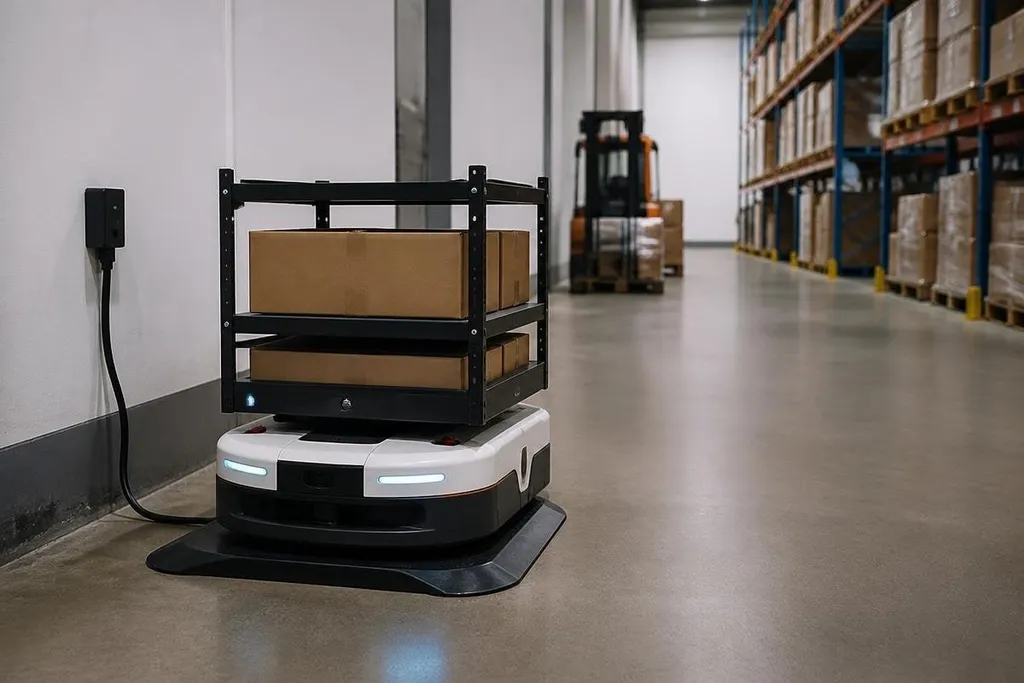
A robot that charges without a plug can keep its route clear and reduce one small maintenance task. The trade-off is less exciting: wireless power works best when the robot can stop in the right place for long enough.
For a warehouse manager, the useful question is not whether wireless charging works. It is whether a charging pad can fit the robot’s route, battery, safety plan, and work rate.
- Best fit: robots that return to known stations
- Main limit: power drops when coils sit too far apart
- Open issue: the full cost depends on pads, controls, and site changes
How wireless charging works
Most robotic wireless chargers use inductive power transfer. A coil in the floor or charging pad creates a changing magnetic field, and a second coil inside the robot turns that field back into electrical power.
The robot still needs a battery, charging controls, and a way to check that it has reached the pad. Wireless power removes the exposed connector from the routine, but it doesn't remove the need for accurate positioning.
That detail matters on a busy floor. A charging contact can wear, collect dirt, or need a person to line it up. A wireless pad avoids that physical contact, yet a robot that stops several centimeters away may charge more slowly or fail to charge at all.
Charging also creates heat. The battery pack, coils, and power electronics all lose some energy as heat, so the system needs limits and temperature checks. The exact loss depends on the hardware, distance, alignment, and power level.
Where it can help
Wireless charging fits robots with repeatable routes. An autonomous mobile robot that returns to the same station can stop over a pad during a short break, then leave when its charge reaches the set level.
That pattern can reduce plug handling and let the robot charge at several points around a site. Small pads placed near work areas may suit robots that pause often, while a larger station may suit a robot that returns between shifts.
The benefit depends on timing. A pad that adds charge during planned idle periods can reduce long stops. A pad that needs the robot to wait in a busy aisle may create a new traffic problem.
The site decides whether that trade-off pays off. Reports on wireless charging from Robot24.com can tie a pad’s power level, charge time, robot route, and floor conditions to the result, so you can see if it cuts downtime before wet or dusty work changes the equipment choice.
Wireless charging also makes sense for robots that work in wet or dusty areas, where an exposed connector may need extra protection. The safety case still needs proof for the site, since dust, water, metal objects, and cleaning methods affect the design.
Where it falls short
Wireless charging is a poor fit when the robot rarely reaches a fixed stop. A delivery robot, inspection robot, or field machine may need power far from a prepared pad, so a removable battery or a wired station may fit the work better.
Distance is another limit. Inductive systems work across a short gap, not across a room. A thick floor covering, a tilted robot, or a badly placed pad can reduce the power that reaches the battery.
Charging speed can also shape the decision. A high-power wired connection may refill a battery faster, while a wireless system may suit slow charging during rest periods. Without the maker’s power, heat, and charge-time figures, the cost case remains unproven.
There is a second site issue: every pad needs power, protection, software settings, and service access. A fleet may need changes to its map so robots stop at the correct point. Those changes can cost more than the pad itself.
I’d choose wireless charging for repeatable routes and planned pauses, not as a default for every robot.
A buying check for a pilot
Use this list before asking for quotes:
- Map the stops: mark where each robot already waits during a shift.
- Measure the gap: check the distance and angle between the pad and receiver.
- Ask for figures: get charge power, charge time, heat limits, and rated distance.
- Check the floor: review water, dust, metal parts, cleaning, and vehicle traffic.
- Price the site work: include wiring, floor changes, software updates, and service access.
A small pilot should measure missed charging attempts, extra waiting time, battery temperature, and work completed per shift. Those results say more than a short demonstration beside a clean charging pad.
Wireless charging can change a robot’s daily routine when the robot already knows where to stop. The next useful proof is a site record showing how often the pad charges the machine without slowing the work around it.